What the teachers of Hamilton view as the challenges facing them.
I was a little surprised by what they mentioned. Access to working technology still seems to be a challenge as does time. Have a quick look at the video to pick up the rest.

My Mum -- Dorothy Winter -- Was a teacher She Motivated me to be a life long learner. The pics in this header show her as a young school girl - to teacher. I will be educhecking in her honour here at educheck.blogspot.com
Showing posts with label personal world. Show all posts
Showing posts with label personal world. Show all posts
Wednesday, June 6, 2012

Wednesday, May 9, 2012
In Our Own time
When we give kids a challenge and some ownership they love it.
They learn as well. Having offered students a chance to come in at lunchtime and work with Lego robotics we have about ten committed students.
They turn up consistently and work on this.
They are experiencing flow.
One of the ideas I am working on with this group is that
this is not a race and to acknowledge their own achievements.
The Temptation is to "borrow code" from others a little further ahead.
With our own efforts well get there and when we do we'll understand more than borrowers.
With our own interests and challenges we are more likely to see this through.
Another quote to support this is "be a maker not a taker"

What Mckenzie had to say about Robotics and their Robot Storm.


They learn as well. Having offered students a chance to come in at lunchtime and work with Lego robotics we have about ten committed students.
They turn up consistently and work on this.
They are experiencing flow.
One of the ideas I am working on with this group is that
this is not a race and to acknowledge their own achievements.
The Temptation is to "borrow code" from others a little further ahead.
With our own efforts well get there and when we do we'll understand more than borrowers.
With our own interests and challenges we are more likely to see this through.
Another quote to support this is "be a maker not a taker"

What Mckenzie had to say about Robotics and their Robot Storm.
Storm "So far we have built our robot. We are currently wireing and putting on our sensors. We downloaded the program we needed to use to program our storm robot.Our robot is basically made out of lego, I like building Storm because it is a great challenge to achieve."


Finally Have a look at this clip that comes without sound.
5 seconds only. What it show is grandparents looking at the kids playing with robotics. I don't think the future is all about robotics but the looks on the faces of grandparents shows how different their learning and lives were.
Sunday, September 11, 2011
How Google Docs Might Help?
During the last school holidays I worked with colleagues looking at the use of Google Docs for literacy and at teacher dashboard an interface layer that works with Google Docs. We asked those present to add their ideas about what they already knew about Google Docs, Teacher dashboard and their use (White Hat – “What information is available” thinking). Let’s start by reflecting on what they said.
TEACHERS: What we already know about Google Docs?
“Lots of people can work at the same time. Documents can be shared with others easily. Students can file away you work in subject areas. That is collaborative and can be accessed anywhere. Useful in collaboration. Edit, change, comment, assess, note label et cetera on work as it happens. That allows teachers to print student work. Helpful to teacher marking-Can edit the same (or a copy of the doc) and send it back to the students are instant feedback and feed forward.”
Or in a wordle

STUDENTS: Key thoughts about working with Google Docs in Teacher Dashboard
Lets us become able to complete our work to a higher neatness and a lot quicker.
Teacher can see it at the same time or I you are working in a group then you can work on bits at a time so one person does not have to do all of the work.
lots of people can work on it as well so it can make the completing of the document much faster and it could have more information on it.
I think that teacher dashboard is easier for us so that we don’t have to keep on sharing our work with Mr Clark, we just have to save it with a title.
It is also really great as Mr Clark / the teacher gets to look at every one's work at once instead one by one.
Or in Tagxedo

.
The students reference the idea of collaboration and the power of this more than the teachers as well as the ease with which everything takes place. The students also seem to have a clearer description of the capabilities within Google documents.
Finally interms of what we think/believe I’d like to outline what I believe will work best for learners using Google Docs and why.
I believe documents with multiple readers and collaborators add most to learning…
These documents allow students to: see how others write and to build on ideas. This motivates them to present themselves well in a highly visible environment. Because others are working with them it is more likely that the work will have meaning beyond compliance (sometimes a significant feature of individual work). We could almost add documents with a purpose on the end of the multiple users and collaborators. I believe we will see more educators working in this way as they come to understand the significance of this new paradigm of access. There are a couple of little tricks and organisational ideas that might help when working with many people to one document. It wont happen overnight but it will happen. I'll put these ideas together into a next post.
As I write this this is a little bit of a broken record element to what I am saying
Time to move on…
My understanding is that people will adopt things, change practice and persist when they have a clear reason for doing so:
so
The next steps are to work and share in a similar environment to the students ourselves for our own learning and modeling…
Wednesday, April 27, 2011
When we make it real…
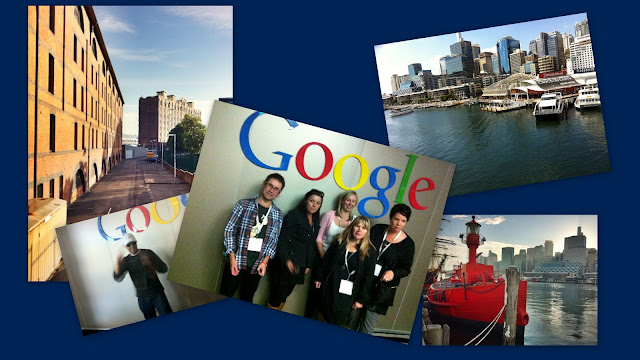
Being back from Sydney for a while now trying to decode try to work out exactly what happened at Google teacher Academy and what it meant. I really enjoyed being in a larger city and especially one so beautiful and vibrant. A visitors experience will be different to a locals.
Our look at google maps and google earth was inspiring. “Our Earth” is a learning bonanza. Thanks Wendy Gorton. Perhaps as a result of this being in this new environment I found the maps information captivating. On reflection maybe other reasons like my long held belief in the power of visual language play a part. Below in a narrated Google Earth Tour I talk about some ways we learn through map/earth exploration.GTASYD from Media team on Vimeo.
Here is a video of howto make a Tour in Google Earth
Monday, October 19, 2009
Looking for acceptable use with head in sand
I was at the Ulearn conference recently where several learners were talking about having a voice, being heard and saying what you think. In these times of change; debate and honesty are needed because the present reality is not the preferred future (the outcome of these debates will determine our direction into the unknown.)
In one workshop, on edupunk a discussion was raised suggesting that because of the danger of pornography and misuse students should not be allowed to have mobile devices in the learning environment. I found myself getting agitated while listening to someone outlining the issue who seemed incredibly reticent to allow mobile devices within the school system due to this risk. Mobile devices are ubiquitous and they are becoming “T H E M A J O R P E R S O N A L” connectivity mechanism.
There is much talk about schooling becoming irrelevant and while I think this is far from the case I would like to argue here that these risks may gain traction in an education system that doesn’t accept its role has changed and that an approach to internet safety must embrace change from within; utilising an ecological approach.


Engage or lose relevance

On a weekday 6 hours is the average time spent in school 18 are spent in the outside world. Sure there is the little matter of sleep and eating but the figure above speaks for itself. When we consider that access to learning technologies is probably greater outside of the school we have a curriculum of self direction. The options for good and bad, sustainable and unsustainable, moral and immoral, positive and negative, creative and consumerist are boundless outside of school. Students are learning more than ever outside of our gates. Our separation of the technological means used in the two environments is an untenable position in the long term and I propose - in the here and now. In waiting to be prepared we may lose our opportunity be part of the ecological development.
The Youth/Teens ie our Students have A participatory culture.
This participatory culture is “a culture with relatively low barriers to artistic expression and civic engagement, strong support
for creating and sharing one’s creations, and some type of informal mentorship whereby what
is known by the most experienced is passed along to novices.A participatory culture is also
one in which members believe their contributions matter, and feel some degree of social connection
with one another (at the least they care what other people think about what they have
created). Forms of participatory culture include:
Affiliations — memberships, formal and informal, in online communities centered
around various forms of media, such as Friendster, Facebook, message boards,
metagaming, game clans, or MySpace).
Expressions — producing new creative forms, such as digital sampling, skinning and
modding, fan videomaking, fan fiction writing, zines, mash-ups).
Collaborative Problem-solving — working together in teams, formal and informal,
to complete tasks and develop new knowledge (such as through Wikipedia, alternative
reality gaming, spoiling).
Circulations — Shaping the flow of media (such as podcasting, blogging).” taken from the confronting the challenges
report from the Mc Aurthur Foundation
| Confronting the Challenges of Participatory Culture: Media Education for the 21st Century |  |
The same report suggests the following and reading it helps me think what our preferred future might be:
“Rather than dealing with each technology in isolation, we would do better to take an ecological
approach, thinking about the interrelationship among all of these different communication
technologies, the cultural communities that grow up around them, and the activities they support.”
My Beliefs are that given the cultural communities that exist for young people are so connected they have the potential to bypass and ignore a formal education system.
Our steps towards a preferable future
- Engage with students in the creation of an AUP that focuses on a vision for digital citizenry
- Understand and explore what kids are doing in the 21st century
- Help learners to learn from each other and from wider connections
- Develop utility and understanding of the contribution points for connected mobile devices
- Allow students to develop and explore suitable ethics and use
- Provide faster cheaper safer (ie filtered but not stifled ) connectivity for mobile devices in our school
- Learn ourselves
- Accept new curriculum
- Take risks (“the best way to predict the future is to make it”)
What this does not mean
This does not mean that learners can have whatever content they like on their phones etc but rather that we understand we will maximise both learning and shared values through adopting acceptable use based on http://www.utechtips.com/aup-driven-by-vision-not-protection/
Tuesday, August 4, 2009
Te Mihi
Been working on my Mihi I have recorded it on utterli as well.
It felt good to find out where I come from and to be able to acknowledge
the Maori language and its part in our identity.
| Taku Mihi | Meaning | |
| Ko David ahau | I am David | |
| Ko Ngati Tahu te iwi | My tribe is Ngati Tahu from the South Island |  |
| Ko Rakeahua te awa | Rakeahua is my River |  |
| Ko Rakeahua te Maunga | Rakeahua is my Mountain |  |
| Ko Alyn taku papa | My father is Alyn |  |
| Ko Dorothy taku mama | My Mother is Dorothy |  |
| | They are both Dead now but their spirit is still with me | |
A good resource for this is here http://www.tki.org.nz/r/language/lls/wehi/units/unit14/index_e.php
Examples from Pt England school are here http://softwareforlearning.wikispaces.com/eStory2
Subscribe to:
Posts (Atom)